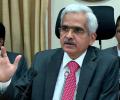
All-out efforts are needed to mitigate the adverse impact of the Covid-19 pandemic, and the RBI will use any instrument necessary to revive growth and preserve financial stability, according to the minutes of the central bank's policy meeting.

There is a view that heavyweight portfolios like home, finance, defence and external affairs besides education and culture, two ministries with strong ideological hues, will be kept by the BJP, while its allies can get anywhere between five to eight cabinet berths.

'Vajpayee used to consult the Opposition; Indira Gandhi used to consult the Opposition. Which khet ki mooli is Modi?'

The Indian equity market clocked record average daily turnover (ADTV) in both the cash and derivatives segments in February amid a spike in volatility. The ADTV for the cash segment for both the exchanges combined came at Rs 1.27 trillion, while the same for the derivatives or the futures and options (F&O) segment stood at Rs 483 trillion in the previous month. The volumes for both cash and derivatives have almost doubled from a year ago on the back of rising retail participation in the world's fourth largest equity market.

To a lay observer, therefore, India today presents two conflicting realities.

The National Human Rights Commission, in its report, also observed that the "pervasive fear of reprisal, coupled with the power dynamics at play, acted as a formidable barrier", preventing individuals from voicing their grievances.

Developing more sources of supplies to guard against disruptions may emerge as the next big trend. But that may not necessarily mean flow of more investments into India, unless investors are assured, besides important economic factors and impartiality of institutions, that social disharmony will not cause unexpected disruptions.

'The current crisis is one of incomes, driven by poor job growth, agrarian distress and poor investment sentiment,' notes Harsh Pati Singhania, director, JK Organisation.

The investment by FIIs in equity instruments amounted to $5.4 billion during April-May 2009, while a turnaround has been noticed in the performance of mutual fund industry that had remained subdued during 2008, the survey stated. The mutual fund investments (net) in equity markets turned positive in March 2009 and were Rs 2,320 crore (Rs 23.2 billion) during April-May 2009, the survey said, adding they invested Rs 36,791 crore (Rs 367.91 billion) in debt instruments.

There are clear signs that the party is re-starting its journey to relevance by going back to its core Panthic agenda, on the basis of which it was founded over a century ago, reports Sai Manish.

With the fresh wave of COVID-19 plunging the hospitality sector back into uncertainty, industry body HAI on Monday said it has asked the government to consider granting infrastructure status to hotels, extend moratorium on loans and rationalise taxes. In its pre-Budget memorandum, the Hotel Association of India (HAI) said policy interventions are imperative for the sector's survival and its early and quick rebound to normalcy. "The hospitality industry was slowly getting into a recovery mode on the strength of domestic tourism - leisure and events, only to be plunged back into uncertainty on account of the Omicron threat.

The finance ministry and RBI must get less conservative and improve co-ordination.
The new prime minister should learn from the mistakes of the current government and pay more attention to inflation.

Ravindra Jadeja's superb all-rounder show powered Chennai Super Kings to a thumping 28-run victory against Punjab Kings.

'We can save 70 patients out of 100, if they reach a hospital well within time.' 'The most crucial aspect is time.'

Finance Ministry had pegged the growth at 5.7 per cent and RBI at 5.5 per cent.

Sajjid Chenoy, India economist at JP Morgan is the new part-time member.

'Mere fundamentals will not do the trick,' cautions former commerce secretary Rahul Khullar.

The Centre's capital expenditure (capex) outlay for the April-June quarter (first quarter, or Q1) of 2022-23 (FY23) could be close to Rs 1.5 trillion, Business Standard has learnt. As a percentage of full-year capex Budget Estimates (BE) of Rs 7.5 trillion, this could be at similar levels to the trends in the past few fiscal years. It is in the July-September quarter (Q2) of FY23 that capex is expected to pick up, when a bulk of the long-term capex loans to states are expected to be expended.

Lou also spoke about China's tensions with neighbouring countries without directly mentioning the eastern Ladakh border standoff with India since May 2020 which resulted in the Galwan Valley clash in June of that year.
The new government will have to start by addressing some key policy concerns, says Ganesh Natarajan, and draws up a checklist. Continuing our series on the state of the Indian economy ahead of the general elections.

He urged China to bolster the flow of its tourists to the Maldives.

Stocks in the automotive, financial, cement, metal, and hotel sectors are likely to benefit if the Narendra Modi-led Bharatiya Janata Party (BJP) comes back to power for a third time. The key investment themes have been identified after analysing the Sankalp Patra - the party's manifesto for the next five years - released on Sunday.

The actual expenditure will only be marginally higher and hence, the multiplier effect will be muted.

With general elections on the horizon, the government's privatisation bandwagon has almost but stalled as a government wary of being accused of selling family silver opts for minority stake sales on stock exchanges over outright privatisation. The result -- the divestment target for current fiscal year is again likely to be missed. Big ticket privatisation plans such as that of Bharat Petroleum Corporation Ltd (BPCL), Shipping Corporation of India (SCI) and CONCOR are already on the backburner and analysts feel meaningful privatisation can happen only after April/May general elections.
Arvind Panagariya is widely expected to take a top advisory role in prime minister-elect Narendra Modi's government.

Finance Minister Arun Jaitley on Friday tabled the pre-Budget Economic Survey in the Lok Sabha.

Observing that the economic recovery was not yet fully entrenched, the RBI Governor said recovery is likely to be gradual.

Even after the government data showed a sharp fall in FY12 growth numbers and the April factory output data at a poor 0.1 per cent, a leading economic think tank on Thursday said it expects a revival in fortune and pegged GDP growth for the current fiscal at 7.3 per cent.

Where do Vijay and his TVK expect to get their votes from? Vijay has a huge fan following among women, but will they automatically become his voters like they had done for MGR's AIADMK, asks N Sathiya Moorthy.

Operating margins have been the primary driver of corporate earnings in India in recent quarters, despite revenue growth suffering from weak consumer demand. Companies across sectors have reported a sharp improvement in earnings before interest, tax, depreciation, and amortisation (Ebitda) margins over the past two years, benefiting from lower commodity and energy prices. Higher margins more than compensated for slower revenue growth, resulting in double-digit growth in net profit for five consecutive quarters.
India's economic revival also depends on the government's capacity to push through some critical policy reforms in the coming months, says the Economic Survey 2008-09, which was\npresented by Finance Minister Pranab Mukherjee in Parliament on Thursday.

The external affairs minister said the SAARC is in trouble as one of its members has been supporting terrorism.

Despite multiple headwinds at the start of 2023, the Indian markets delivered a strong performance, posting 19-20 per cent growth for the year. Even as new records were set, investor sentiment remains strong going into 2024, given the lower inflation, expectations of steady to lower interest rates, higher economic growth, and strong inflows. However, the overriding concern for most brokerages is valuations.
2013 will go down as an "annus horriblis" for the Indian economy. Instead of a growth rate over 10 per cent and inflation under 5 per cent we have the reverse.

'Interim Budget has ignited the entrepreneurial spirit.'

Have the markets already played out their dynamics before the economy has even properly taken off? Are we now destined for a period of mediocre returns despite a strong economy? asks Akash Prakash.
If Mr Modi is not in favour of privatisation, he should outline what alternative strategies he has in mind to revive PSUs whose deteriorating finances have become a drag on central resources.

In order for life insurance customers to attain maximum benefits, it is crucial for the persistency ratio to be far higher than its current level, top executives of the industry said at the Business Standard BFSI Insight Summit on Thursday. The persistency ratio is a metric that measures the number of policyholders who continue paying renewal premium and is gauged at varying stages in the life of a policy. A higher persistency ratio is seen as an indicator of an insurance product that caters satisfactorily to the needs of a customer.
 © 2026 Rediff.com - Advertise with us - Disclaimer - Privacy Policy - Sitemap - Feedback - About us - Terms of use - Grievances